Hydraulic Cylinder Repair Bench for Excavators: Why It’s Worth It
You’re on a job. The excavator is ready to work. And then—you notice something wrong.
A wet rod. A drip at the gland. Slow, mushy power. Or worse—your boom starts drifting when it shouldn’t. A hydraulic cylinder has failed.
You realize the job is a wash, and you’re already running through some scenarios in your head:
- “Can I limp this thing through the week?”
- “Can I rebuild that cylinder myself?”
- “Do I trust the local shop… and their turnaround time?”
Here’s the part most people learn the hard way:
Hydraulic failures on excavators are a serious problem. Excavator boom, stick, and bucket cylinders are not the place to “make do” with straps, blocks, and a pipe wrench. With the contents of the cylinder under immense pressure, there’s no seat-of-the-pants work here. You need precision to do the job.
That’s where Cylinder Cyclone™ comes in. You want repairs that are safe, fast, and consistent. You need a hydraulic cylinder repair bench designed for excavators and more—a purpose-built bench that holds, opens, rebuilds, and reassembles large cylinders with precision.
And if you run a small repair shop? A proper bench isn’t just equipment.
It’s the key to your reputation—It’s how you become the hydraulic cylinder repair expert in your region!







TL:DR - Hydraulic Cylinder Repair Bench for Excavators
- Excavator cylinder repairs require a professional bench for precision, as high-pressure components are unsafe to work on with common tools.
- Common failures include external leaks, internal leakage (causing "drift"), rod damage, and contamination-driven wear.
- Without a proper bench, repairs are dangerous due to stored energy, risk of uncontrolled movement, tool slippage, and pinch points.
- A professional bench delivers accuracy, controlled torque, and efficiency, resulting in faster, safer, more consistent results, reduced downtime, and a stronger shop reputation.
Why Excavator Hydraulic Cylinders Require Professional Repair Equipment
Excavator cylinders are built for brutal work. With cylinders containing pressures ranging from 2,500 to 4,500 psi, and even higher in some cases, those boom, stick, and bucket cylinders go through all kinds of abuse every day:
- Heavy loads, often at weird angles
- Shock loads from impacts such as buckets hitting rocks, a tooth catching a root, or an operator bumping a curb
- Dirt and grit everywhere
- Long strokes and big rod diameters
- High pressure that doesn’t forgive mistakes
And the cylinder itself is no lightweight “shop project.”
A large excavator cylinder can be awkward, heavy, and hard to control. Even if you have lifting equipment, the real problem is stability.
Because rebuilding a cylinder isn’t just “take it apart and swap seals.”
Safe, efficient cylinder repairs involve:
- Holding it safely
- Breaking loose tight components without slipping
- Keeping parts aligned
- Assembling cleanly
- Torquing correctly
- Verifying smooth movement and seal integrity
All of these variables can make taking a cylinder apart by hand a risky venture. A professional bench is designed to do those things on purpose—consistently, every time, while keeping these variables under precise control.

Common Hydraulic Cylinder Failures Found in Excavators
Most excavator cylinder problems show up in a few predictable ways.
External leaks
It’s the most obvious one. You’ll see oil around the rod, gland, or ports. Common culprits:
- Worn rod seals
- Damaged wipers from dirt getting pulled in
- rod surface issues (pitting/scoring chews up seals)
Internal leakage
That’s the one that gets you. The machine “feels weak” or drifts. The cylinder may look dry outside, but pressure bleeds past piston seals internally. One common symptom is cylinder drift, often tied to internal leaks and seal damage. Today, the excavator is running slightly off. Tomorrow, it’s broken, and your job is botched.
Rod damage
This is common in excavators because of side-loading and real-world abuse, resulting in:
- bent rods (binding, rapid seal wear)
- scoring from contamination
- corrosion/pitting from moisture and neglect
Contamination-driven wear (the root cause behind many failures)
If you’ve been around hydraulics, you’ve heard it: dirty oil kills parts.
Research literature commonly notes contamination as a major driver of hydraulic system failures—often because particles accelerate wear, cause leakage, and wreck surfaces that seals depend on.
Thread and hardware damage from “improvised rebuilds.”
This one’s more common than people admit:
- Chewed-up gland flats from slipping tools
- Nicked seal grooves
- Galled threads
- Mushroomed rod ends
- Piston nuts installed without proper torque control
And then you get the worst failure type of all:
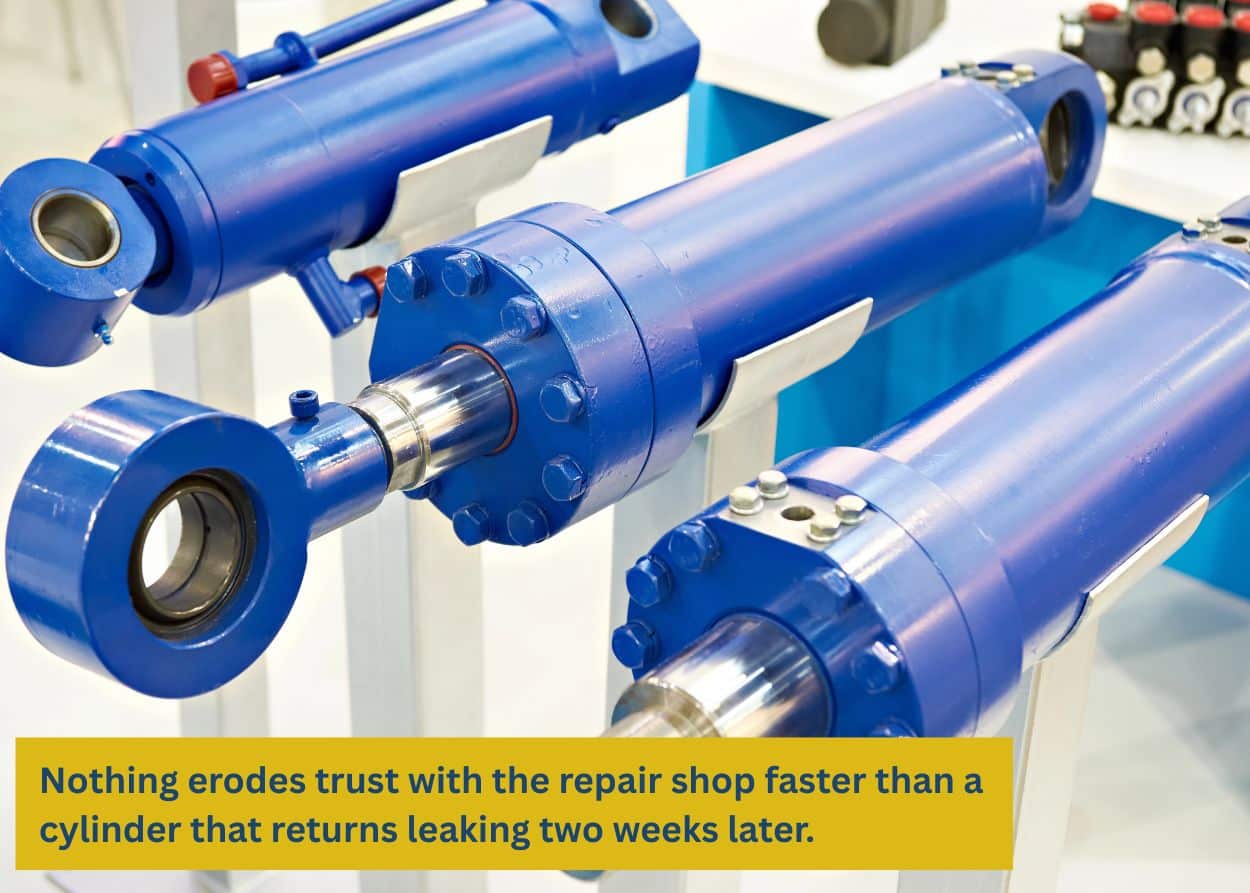
Repeat failures. Nothing erodes trust with the repair shop faster than a cylinder that returns leaking two weeks later.
Safety Risks of Repairing Excavator Cylinders Without a Proper Bench
Hydraulic cylinders are no joke. Here are some of the dangers of improperly disassembling or repairing a hydraulic cylinder without the proper equipment:
The biggest hazards you’re dealing with
It’s not like a tight jar that you can twist off with a monkey wrench.
Rebuilding cylinders without the proper holding and torque setup can injure someone.
1) Stored energy and trapped pressure
Hydraulic systems can retain hazardous stored energy. That’s precisely why lockout/tagout standards focus on preventing injury from unexpected energization or release of stored energy.
Even if the machine is off, pressure can remain trapped in cylinders, lines, and accumulators. Simply shutting down does not guarantee the system is depressurized.
2) Uncontrolled movement (rolling, swinging, dropping)
Improvised stands and “blocking it up” can shift. You want that cylinder secured on the bench.
Remember—a heavy cylinder rolling off a bench isn’t a “whoops.” It’s a hospital visit. Or worse, a career-ending accident.
3) Tool slipping under high force
Breaking loose glands and piston nuts takes serious force. If your holding method isn’t rigid, tools can slip. When they slip, your body is usually in the line of fire.
4) Pinch points and crush zones
Cylinders are basically big leverage machines. The moment something breaks free, parts can jump, rotate, or fall.
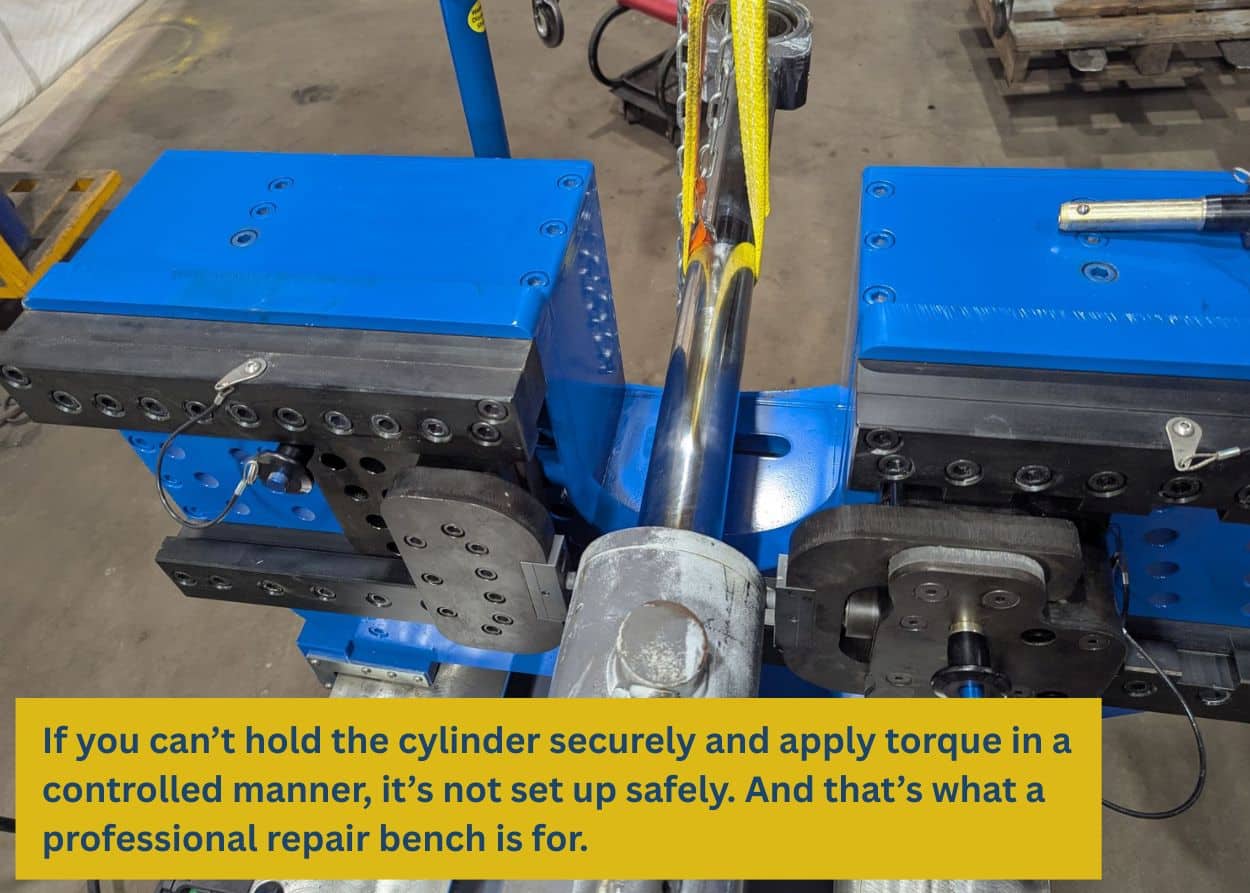
If you can’t hold the cylinder securely and apply torque in a controlled manner, it’s not set up safely. And that’s what a professional repair bench is for.
How a Hydraulic Cylinder Repair Bench Improves Accuracy, Torque Control, and Efficiency
A Hydraulic Cylinder Repair Bench for Excavators isn’t just a fancy table.
It’s a system that turns a risky, variable process into a predictable, repeatable one. With a hydraulic cylinder repair bench, you get:
Accuracy: keep parts aligned and assemblies true
When a cylinder is clamped correctly and supported, you reduce:
- Rod misalignment during assembly
- Accidental damage to seals and wear rings
- Thread cross-up from fighting “off-angle” parts
- Contamination from parts dragging on dirty surfaces
Translation: fewer comebacks.
Torque control: stop guessing and start building confidence
Correct torque matters. Under-torque can loosen the cap. Over-torque can damage threads, distort parts, or create binding.
Industry guidance on torque tools consistently emphasizes that calibrated torque helps achieve proper joint tension and clamping force—both key to assembly integrity and reliability.
A good bench setup helps you apply torque smoothly and safely—especially when paired with proper torque tooling and procedures.
Efficiency: faster teardown and rebuild (with less drama)
A bench improves workflow because it:
- Holds the cylinder at a working height
- Allows rotation and positioning without wrestling it
- Reduces resets and re-clamping
- Supports one-tech operation in many cases
- Speeds up disassembly and reassembly with controlled force
And one underrated benefit: It reduces mental load. Automation improves safety and enables your technician to focus on repairing the cylinder. When the cylinder is stable, the work is calmer, cleaner, and more professional.

How Faster, Safer Repairs Reduce Downtime and Build Local Authority
Whether you’re an owner-operator or a small shop, downtime is the enemy.
A down excavator doesn’t just sit there politely. It sits there, staring you in the face, and:
- Delays the job
- Ties up crews
- Creates rescheduling headaches
- Pushes deadlines into contract delays and bad weather
- Burns money every hour it’s idle
Industry experts recognize that heavy equipment downtime can range from hundreds to thousands of dollars per hour, depending on the job and its ripple effects.
But if you’re the local shop that can rebuild big excavator cylinders with confidence, a bench helps you deliver:
- Shorter turnaround times
- More consistent rebuild quality
- Fewer leaks and rework
- Cleaner, more documented processes
- Safer work practices (which matter for your team and your insurance premium)
And that creates something powerful:
Local authority.
Contractors and fleets remember two things:
- Who got them back running fast, and
- Who fixed it so it stayed fixed
That’s how you become the shop everyone recommends—the hydraulic repair expert in your region.
But it’s not as simple as picking up the first hydraulic cylinder repair bench that comes up. You’ll need to invest in a bench that meets your needs. Let’s talk about what to look for next.
What to Look for in a Hydraulic Cylinder Repair Bench for Excavators
Not all benches are created equal. Excavator cylinders demand more.
Here’s a practical checklist to guide your decision.
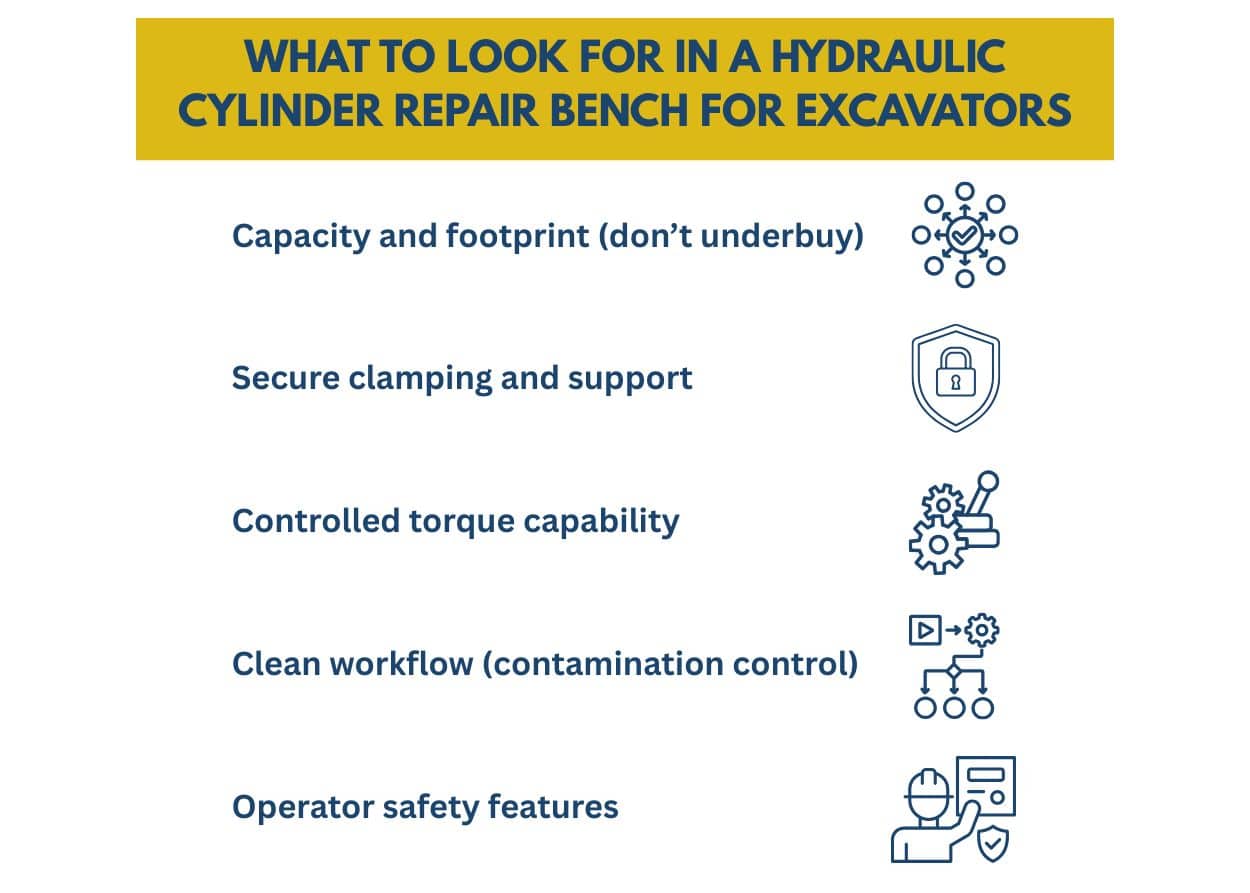
Capacity and footprint (don’t underbuy)
You want something that you won’t outgrow. Look for:
- A cylinder length and diameter capacity that matches the boom/stick cylinders you actually see come into your shop
- A stable frame designed for heavy loads
- A clean design that allows room to work around the cylinder without tripping over stands and chains
- Modularity that allows for future expansion
Secure clamping and support
You want holding power that doesn’t shift under torque. This means:
- Adjustable supports
- Robust clamping surfaces
- Fixtures that don’t damage tubes/rods
Controlled torque capability
This is where real quality shows up.
A good setup supports:
- Safe, repeatable torque application
- Consistent disassembly/reassembly procedures
- Fewer “pipe-on-a-wrench” moments
Clean workflow (contamination control)
If contamination drives failures, your rebuild process should fight contamination.
Look for:
- Good access for cleaning components
- A workflow that keeps parts off the floor
- Space for organized parts staging and inspections
- Waste oil collection and disposal to keep the work area clean
Operator safety features
At minimum, your bench should provide:
- Stable cylinder positioning
- Reduced slip risk during high-torque steps
- compatibility with safe lifting practices
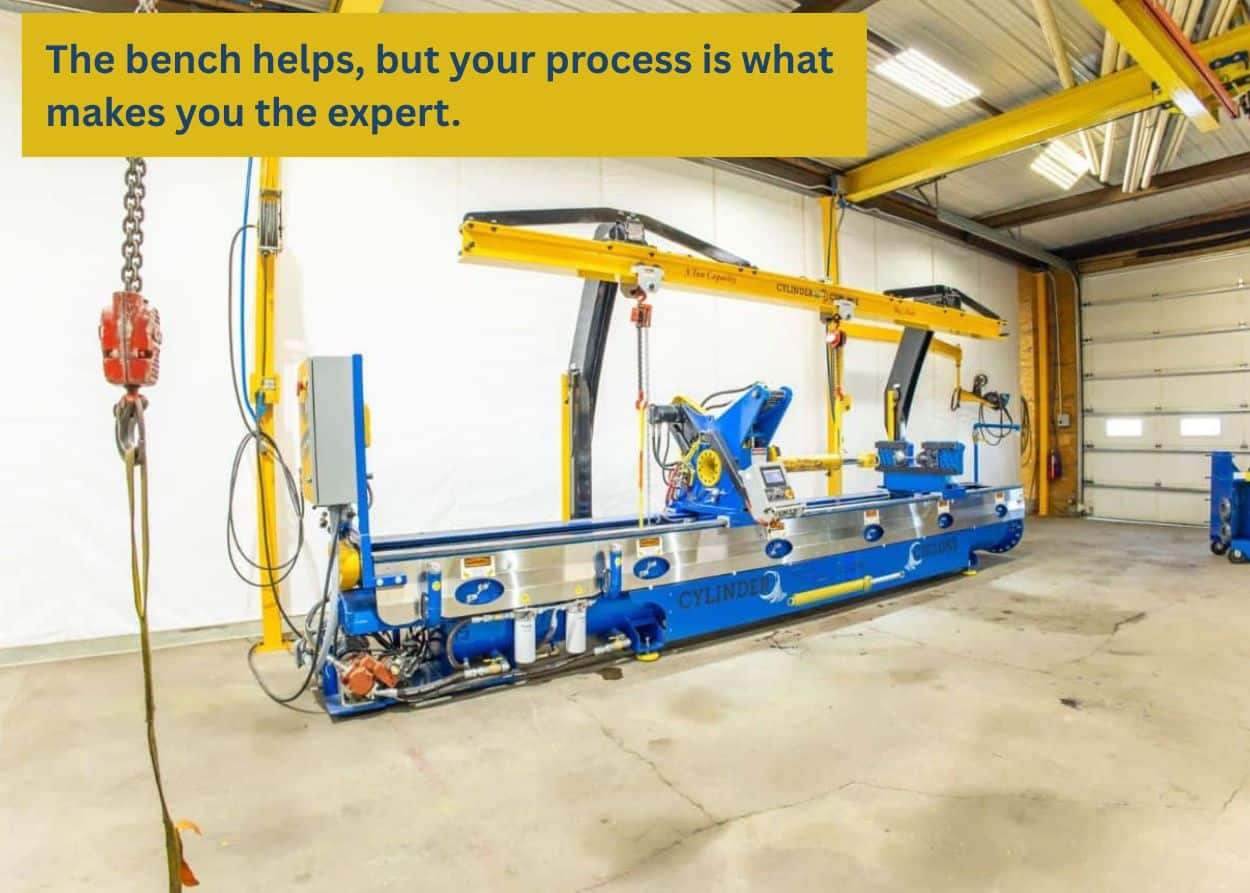
And always: training and procedures. The bench helps, but your process is what makes you the expert.
The Bench Isn’t the Flex—The Results Are
Any shop can “rebuild cylinders.”
But only a properly equipped shop does it in a way that’s:
- Safe
- Efficient
- Repeatable
- Professional
That’s what the Cylinder Cyclone™ Hydraulic Cylinder Repair Bench supports. Whether it’s for excavators, cranes, trucks, or other equipment, our benches will help your team work efficiently and quickly, and, best of all, increase your bottom line without compromising safety or morale.
Less downtime. Better quality. Fewer comebacks—And the reputation that comes with it.
Contact us and get on the path to being the hydraulic repair expert in your region!