Hydraulic Cylinder Repair Benches: What They Are, How They Work, and Why They Matter
If your equipment runs on hydraulics, the cylinders inside those systems do the heavy lifting—literally! When a cylinder leaks, bends, or loses power, your whole operation slows down, or worse, you experience a catastrophic failure.
That’s where hydraulic cylinder repair benches come in. These machines provide technicians with a safe, stable, and robust workspace for disassembling, rebuilding, and testing cylinders correctly, quickly, and precisely.
At Cylinder Cyclone, we’ve put a lot of thought into our patented system, designed from the ground up for ease of use, precision, and quick turnaround for maximum profitability. We’re familiar with the trials and tribulations of hydraulic cylinder repair, and today we’ll talk about why it’s a quantum leap in capability compared to manual repair methods.
Ready? Let’s get started!







TL:DR - Hydraulic Cylinder Repair Benches
- Purpose-Built Machine: A hydraulic cylinder repair bench is a dedicated workspace designed to safely clamp, rotate, torque, and assist with the precise disassembly and reassembly of hydraulic cylinders, eliminating the need for improvised manual methods.
- Key Features: Essential features include a heavy-duty frame, adjustable clamping, smooth powered rotation, high-torque nut running for stubborn piston nuts, and integrated hydraulics for controlled rod extension and optional pressure testing.
- Core Benefits: A dedicated bench dramatically increases speed, transforming a multi-hour, two-person job into a one-tech workflow; improves precision through controlled torque; and enhances safety by securing the work and reducing physical strain and pinch point hazards.
- Strong ROI: Investing in a repair bench leads to a significant return on investment (ROI) by cutting turnaround time (e.g., from 5-6 hours to 0.5 hours with a Cylinder Cyclone bench), reducing repeat failures (callbacks), and boosting customer satisfaction and shop profitability.
What Is a Hydraulic Cylinder Repair Bench?
A hydraulic cylinder repair bench is a purpose-built machine designed to clamp, rotate, torque, and assist with the disassembly and reassembly of hydraulic cylinders. Think of it as a safe, controlled work area that gives the technician leverage and precision without fighting the cylinder on the floor or a basic worktable.
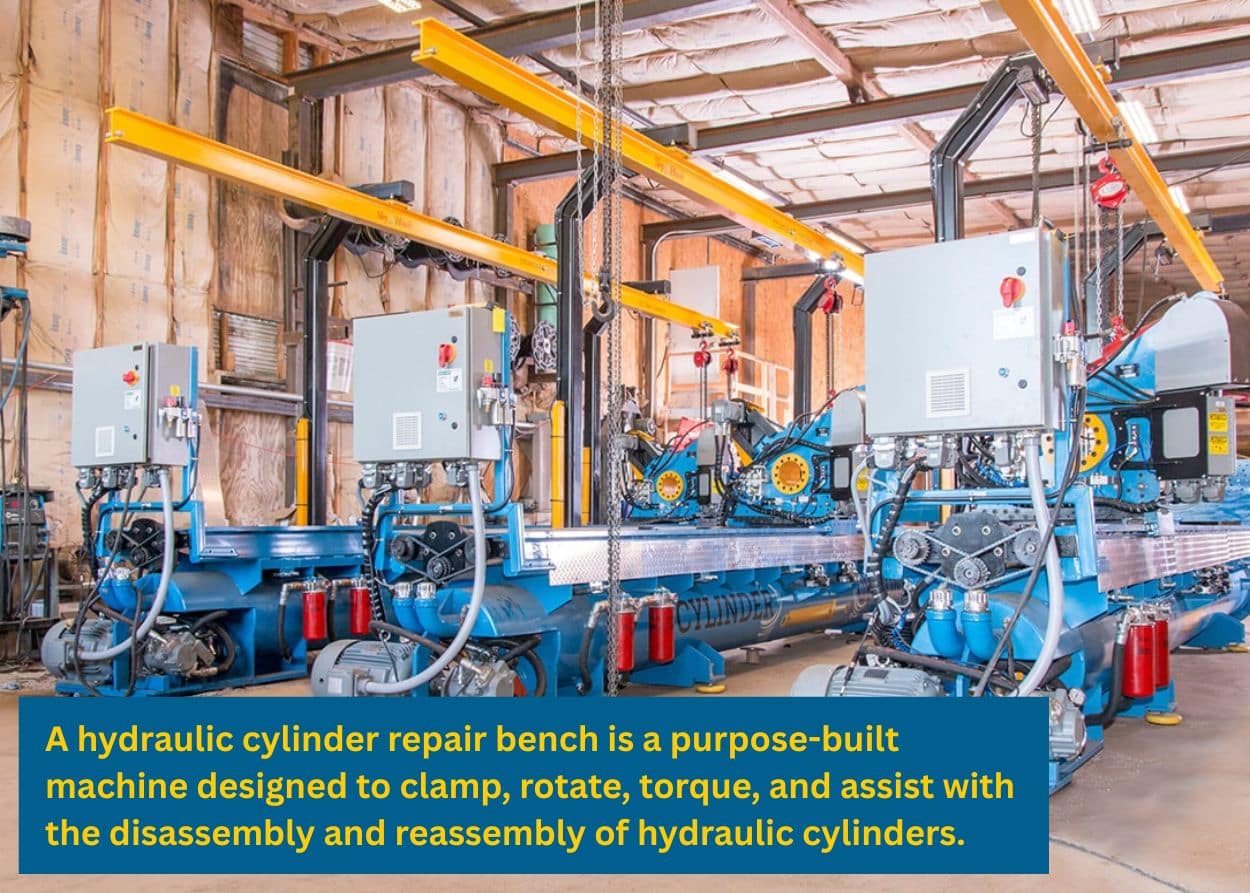
What a bench typically includes:
- Heavy-duty frame and bed: To support long, heavy cylinders.
- Adjustable clamping system: Holds barrels and rods steady so parts don’t twist or slip.
- Powered rotation: Turns the cylinder smoothly for access to all sides.
- High-torque nut running: Breaks stubborn piston nuts loose and re-torques them to spec.
- Integrated hydraulics: Runs tools, extends/retracts rods, and supports testing.
- Safety systems: Shields, guards, E-stops, and controlled movements protect the operator.
With a hydraulic cylinder bench, your business gains the following benefits:
- Faster, more efficient teardown and assembly.
- Reduced risk of part damage.
- Improved torque accuracy and seal installation.
- Safer and less fatigued operators.
Who Uses Repair Benches? Three Everyday Examples
Whether you work in construction, agriculture, trucking, or general manufacturing, a quality bench helps you fix cylinders faster, safer, and with better results.
Construction:
An excavator’s boom, stick, and bucket cylinders see high loads and dirty conditions, leading to constant wear and tear. A repair shop uses a bench to clamp the tube, twist off gland nuts, pull the rod, replace seals, and re-torque to spec. The result is a faster turnaround and fewer call-backs on large, hard-working cylinders.
Agriculture:
A dairy farm’s compact tractor has a loader cylinder leaking at the rod seal. A bench lets the tech safely remove the gland, change seals without nicking the rod, and reassemble with the correct torque. The tractor is back feeding and scraping alleys the same day.
Trucking:
A hauler’s dump trailer cylinder is creeping (also known as drift) down under load. On a bench, the tech inspects the piston wear rings, replaces seals, and verifies the cylinder holds pressure before re-install. The truck keeps on truckin’ instead of sitting in the yard.

As you can see, hydraulic cylinder repair benches play a vital part in keeping local businesses up and running.
How a Hydraulic Cylinder Repair Bench Works (Step by Step)
What’s it like to work with a hydraulic cylinder workbench? Details vary by bench model, but the core steps stay similar:
- Set and secure.
Lift the cylinder onto the bench, set the supports, and clamp the barrel and rod. The goal is zero movement while you work. - Open the cylinder.
Use the bench’s powered tools to loosen the gland or cap and the piston retaining nut. Controlled torque and rotation prevent damage. - Extract the rod assembly.
Extend the rod hydraulically and remove it. The bench handles the force, so you don’t. - Inspect and measure.
Check the rod for scoring or bending. Inspect the barrel ID, piston, wear rings, and threads. Measure critical dimensions. - Clean parts.
Clean the barrel, rod, and components to ensure new seals seat correctly. Clean parts make clean repairs. - Replace seals and wear items.
Install quality seals, backup rings, and wear bands. Lubricate as recommended. - Reassemble with controlled torque.
Reinsert the rod, set the piston, and torque the nut to spec with the bench’s torque control. Re-install gland/cap. - Function test (and pressure test if equipped).
Stroke the cylinder to check smooth travel and leaks. If your setup includes test capability, verify it holds pressure before it leaves the bench. - Document and tag.
Note parts used, torque values, and test results. Label the cylinder so installers know it’s ready.

Key Features to Look For in a Repair Bench
Not all benches are built the same. Match your bench to the cylinders you service most often and the safety and productivity goals of your shop. You’re looking for:
- Capacity and Length
Choose a bed length and weight rating that covers your biggest cylinders. A bit of extra capacity adds flexibility to your business, just in case a customer sends you a cylinder that’s slightly larger than what your shop usually gets. - Clamping and Supports
Adjustable, non-marring jaws support and prevent rotation and sagging. Good clamping equals safe, precise work. - Powered Rotation
Rotating the cylinder on the bench reduces handling time and lets you safely access all sides without re-rigging. - High-Torque Nut Running
Breaking a stuck piston nut is where injuries and part damage happen with improvised methods. A bench with proper torque control saves time, parts, and trips to the emergency room.

- Integrated Hydraulics
On-bench hydraulics let you extend/retract rods, operate fixtures, and test movements, creating a controlled, simulated environment to ensure the work is performed correctly. - Safety Systems
Emergency stops, guarded pinch points, remote or foot-pedal controls, pressure relief systems, and shields help keep people safe. - Measurement and Setup Aids
Scales, stops, and simple fixtures help repeat steps, reduce errors, allow for documentation, and improve speed.
Why a Dedicated Bench Beats Manual Methods
How do the features above translate to cylinder repair? Here’s how:
Speed:
A bench turns a two-person wrestling match into a one-tech workflow. Teardowns that used to take hours drop to a fraction of the time because clamping, torque, and rotation are built in.
Precision:
Torque control means piston nuts aren’t under- or over-tightened. Proper clamping keeps rods and tubes aligned so seals seat correctly and threads don’t gall.
Safety:
The bench holds the work. That means fewer pinch points, fewer flying parts when a stuck gland breaks loose, and less strain and injury risk from prying heavy components off the floor.
Consistency:
Repeatable setups and steps mean your tenth cylinder of the week is repaired just as well as your first.
Cleaner Work:
Keeping parts secure and level makes cleaning easier. Clean assemblies last longer.
A further comparison of a cylinder repair bench vs manual methods further drives home the point:
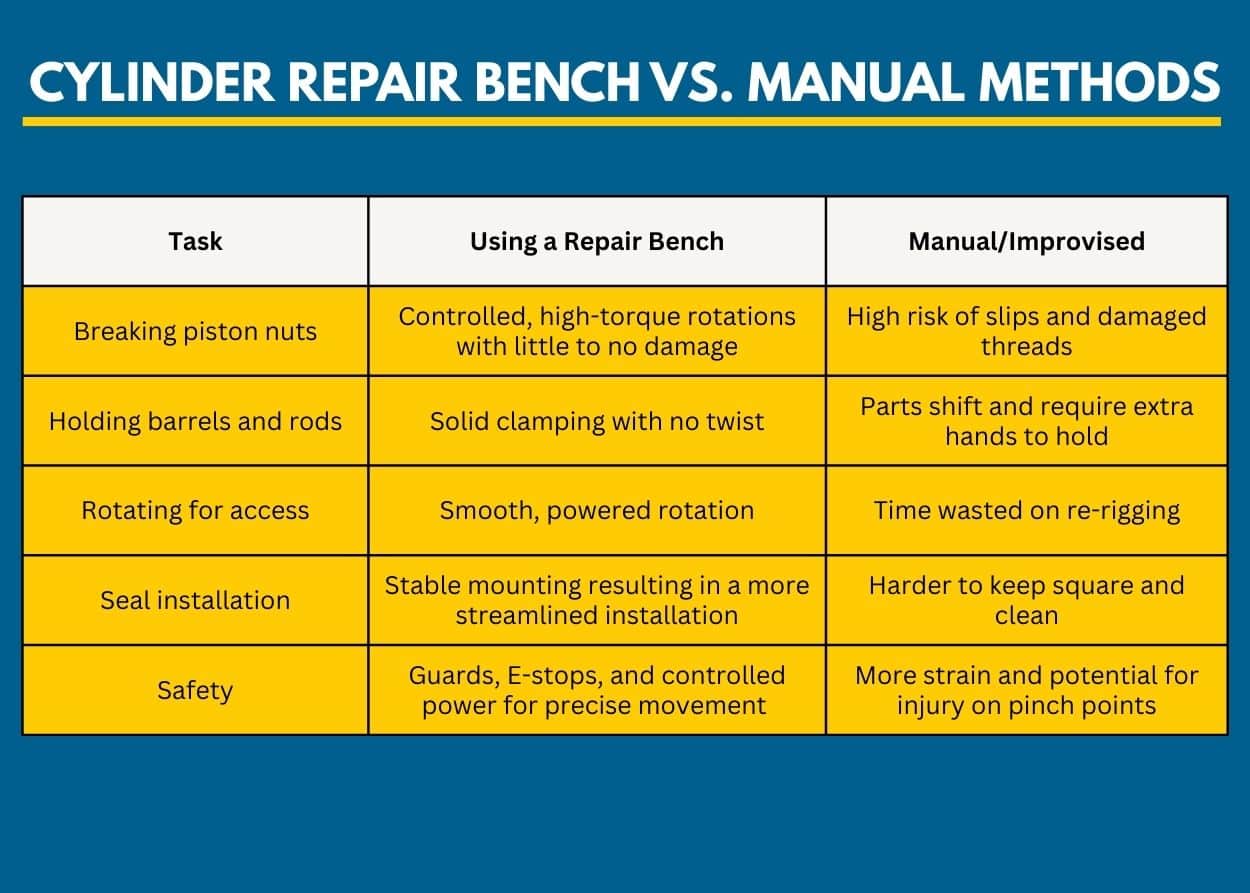
The bottom line? A dedicated repair bench makes hydraulic cylinder repairs routine!
The Business Case: Downtime, Quality, and ROI
Every hour a machine is down costs money. A repair bench helps on two fronts: it reduces repair time and reduces repeat failures. A Cylinder Cyclone doubles down and gives you dramatically reduced turnaround times.
- Faster Turnaround:
If a manual teardown takes 5–6 hours with two people, a Cylinder Cyclone will have you tearing down, repairing, and pressure-testing in as little as 0.5 hours, with one technician. Multiply that time savings across a week, and you’ll free up serious capacity. - Fewer Callbacks:
Correct torque and clean assembly reduce early leaks and failures. Fewer callbacks mean more billable work, happier customers, and invaluable loyalty. - Safer Labor = Lower Risk:
With safer handling and fewer “hero” lifts, your injury risk and fatigue go down, while productivity and morale go up. Your liability insurance will love you, too.
A simple ROI scenario:
Let’s say you have a Cylinder Cyclone in your workshop. With the improved efficiency, you can charge 5–6 times the hourly rate.
- Save 4.5 hours per cylinder × 8 cylinders/week = 36 hours/week.
- At $100/hour for labor, that’s ~$3,600/week, or ~$187,200/year in recovered capacity—before counting reduced comebacks and better safety.
Your numbers may differ, but the direction is the same: More billable work done in less time, efficiently and safely.
A quality cylinder repair bench that provides quick turnaround also provides an intangible ROI—customer satisfaction and loyalty. The goodwill generated by the speed and accuracy of your work will keep you at the top of their call list the next time they need a repair.

Pump Up Your Cylinder Repair Business!
Hydraulic cylinder repair benches are not “nice to have”—they’re a “must have”: the safest, fastest, and most consistent way to rebuild cylinders. With strong clamping, controlled torque, powered rotation, and built-in safety, a bench helps you cut downtime, improve the quality of your work, protect your team, and extend the life of your customer’s equipment.
If you’re ready to upgrade from improvised methods to a dedicated, professional setup, investing in the right bench is one of the smartest moves you can make for your shop and your customers.
At Cylinder Cyclone, our patented cylinder repair bench is trusted by shops across the U.S. Our solutions focus on safety, speed, and repeatable quality—so your team can do more, in less time, with fewer headaches. Based in Harrisonburg, VA, we support customers nationwide with friendly service and reliable parts.
Want help sizing a bench for your typical cylinders? Let’s talk!
Contact us today, and we’ll work with you to pick the right capacity and options for your shop!