How to Choose the Right Hydraulic Cylinder Repair Bench
If you rebuild or service hydraulic cylinders, the right repair bench is not a luxury—it’s the core of a safe, efficient shop; the one place you simply cannot afford to cut corners.
But what cylinder bench should you invest in?
At Cylinder Cyclone, we understand that there’s too much money at stake to fumble the decision. That’s why we wrote this guide to walk repair shop owners, maintenance teams, and equipment managers through the process of choosing the right hydraulic cylinder repair bench. We base our recommendations on the types of cylinders you handle, the safety requirements you must meet, the available space, and the expected return on investment.
Are you pumped to learn more? Let’s get started!







TL:DR - How to Choose the Right Hydraulic Cylinder Repair Bench
- The right hydraulic cylinder repair bench is crucial for a safe and efficient shop, and the decision should not be taken lightly.
- Consider the types of cylinders you work on, including their sizes, pressures, and repair volume, to determine the necessary bench capacity and features.
- Key features to look for include sufficient capacity and holding power, fine torque control, appropriate tooling, adjustable fixturing, and non-negotiable safety systems.
- Plan your shop layout to accommodate the bench, ensuring sufficient space, proper material handling, adequate power, sufficient lighting, and effective contamination control.
- Evaluate durability, maintenance requirements, and manufacturer support, and build a simple ROI to justify the investment, considering factors like time saved, reduced rework, and improved safety.
Interested in knowing more about choosing the right hydraulic cylinder repair bench? Read on!
Start With Your Work: Sizes, Pressure, and Volume
Maintaining and repairing cylinders is complex work. Before shopping for the perfect bench, map out what you actually need to fix. Cylinder benches are pretty specialized, so a bench that’s perfect for light tie-rod cylinders may struggle with big welded or telescopic cylinders—and vice versa.
Make a quick worksheet to determine your needs:
- Cylinder types: What kind of cylinders do you work on? Tie-rod? Welded? Telescopic? Double-acting? Single-acting?
- Largest jobs: Think about the greatest max bore, rod diameter, stroke, and overall lengths you’ve seen coming through your shop.
- Biggest threaded nuts/glands: You’ve got to be nuts not to consider the largest sizes and whether you meet stubborn, rusted, or lock-wired glands on the line.
- Typical pressures: System working pressures you’ll test to, and any proof pressures specified by customers or OEMs.
- Repair volume: Average cylinders per week, peak season volume, and mix (e.g., 60% ag cylinders, 40% construction/industrial).
- Handling: How you move cylinders around? Consider if you’ll need an overhead crane, jib, forklift, or cart.
- Contamination sensitivity: Cleanliness demands better filtration and oil handling. You’ll build cleaner cylinders, and your technicians will thank you, too.
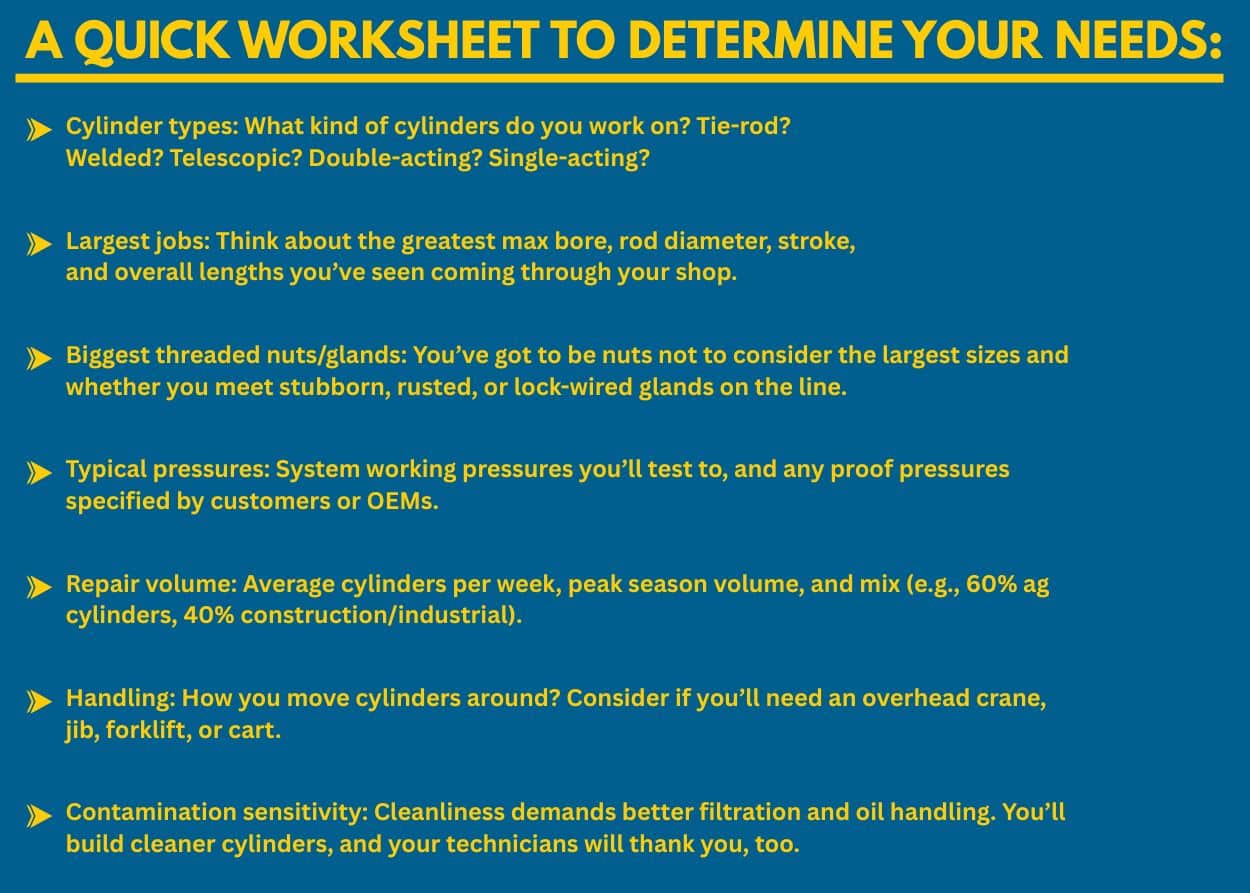
Why this matters: your answers point straight to the capacity, torque, fixturing, and test options a bench must have—and what you can skip.
Key Features to Look For (and Why They Matter)
When comparing benches, match the features to the corresponding items in your worksheet. The list below is what most high-performing cylinder shops rely on.
A. Capacity and holding power
- Push/pull force for breaking loose stubborn glands and caps.
- Rotational torque capacity for safe, controlled unscrewing of threaded retainers.
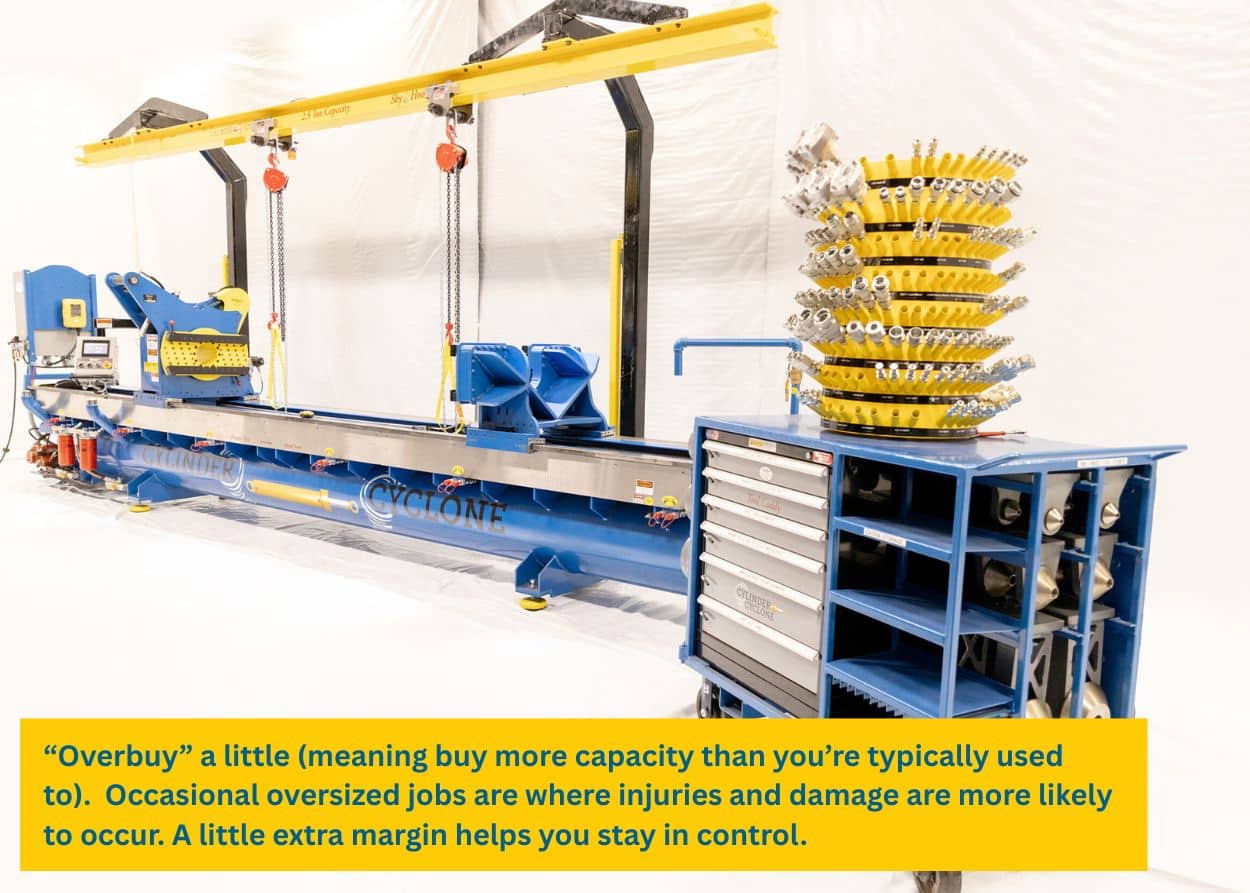
- Overhead self-centering crane system to lift, center and support cylinders while they’re being worked on.
Tip: “Overbuy” a little (meaning buy more capacity than you’re typically used to). Occasional oversized jobs are where injuries and damage are more likely to occur. A little extra margin helps you stay in control.
B. Torque control and tooling
- Fine torque control (and readout) helps prevent thread damage on reassembly.
- Gland/nut tooling: Interchangeable jaws, strap tooling, or sockets that won’t mar chrome or crush thin-wall parts.
- Thread protection: Pusher pads and protectors that won’t mushroom rod ends.
- Hands-off options: Remote control or foot pedals for controlled, eyes-on operation.
C. Fixturing and adjustability
- Adjustable headstock/tailstock for varying cylinder lengths.
- Live centers/rod supports to keep rods aligned and protect seals and chrome.
- Quick-position slides allow one technician to set up safely without wrestling with heavy parts.
D. Safety systems (non-negotiable)
- Emergency stop within easy reach.
- Interlocked guards/shields that prevent hands from entering pinch and rotation zones.
- Clear pinch-point labels to ensure that technicians are aware of areas on the bench that could be hazardous.
Also, factor in task-based risk assessment and guarding aligned with ANSI B11 series guidance for machinery safety—good benches make compliant guarding and procedures practical in daily use.
E. Test and filtration options
- Integrated or companion pressure-test stand with a readable gauge or digital transducer.
- Return-line and/or kidney-loop filtration to protect components and reduce comebacks.
- Oil containment: Utilize drip trays, splash shields, and clean fluid management to maintain a safe and tidy bay.
- Caution: Never exceed the component’s design/test pressure! System changes intended to increase pressures must be reviewed by the OEM or a competent engineer.

F. Build quality and serviceability
- Rigid welded frame (not flimsy platework) to prevent twist and misalignment.
- Quality hydraulics (valves, hoses, cylinders) and neat routing for easier maintenance.
- UL-listed control panel and clearly labeled circuits.
- Grease points, hose labels, and accessible wear parts so daily checks are quick.
Space and layout: fit it to your flow
Even the best bench can struggle in a poorly laid-out space. Plan the bay so that technicians can move heavy parts safely and keep the work moving smoothly.
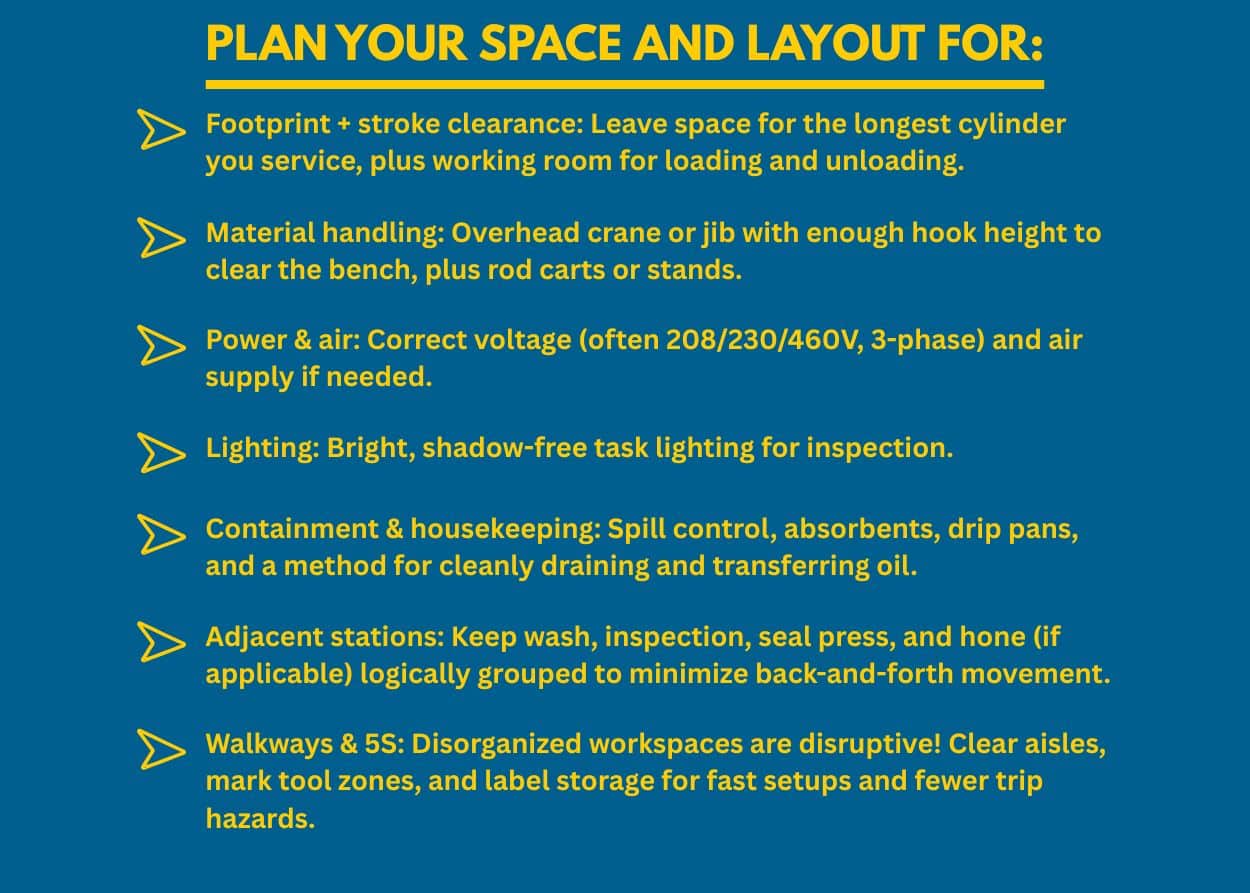
Plan for:
- Footprint + stroke clearance: Leave space for the longest cylinder you service, plus working room for loading and unloading.
- Material handling: Overhead crane or jib with enough hook height to clear the bench, plus rod carts or stands.
- Power & air: Correct voltage (often 208/230/460V, 3-phase) and air supply if needed.
- Lighting: Bright, shadow-free task lighting for inspection.
- Containment & housekeeping: Spill control, absorbents, drip pans, and a method for cleanly draining and transferring oil.
- Adjacent stations: Keep wash, inspection, seal press, and hone (if applicable) logically grouped to minimize back-and-forth movement.
- Walkways & 5S: Disorganized workspaces are disruptive! Clear aisles, mark tool zones, and label storage for fast setups and fewer trip hazards.
Reminder: Hydraulic work brings injection-injury risk. Good layout, guarding, and procedures lower exposure; training should cover injection hazards and safe leak detection (no bare-hand “feel” checks).
Durability, maintenance, and manufacturer support
A cylinder bench earns its keep for years to come. Durability and support help maintain your high uptime.
- Structural details: Heavy sections, clean welds, and true mounting surfaces so parts align and threads start correctly.
- Hydraulic plumbing: Quality hose, proper bend radii, abrasion sleeves, and tidy clamps to reduce rub-through.
- Controls & wiring: Clear schematics, labeled terminals, and protected cable runs for quick troubleshooting.
- Documentation: Manuals, parts lists, hydraulic/electrical prints, and a preventive maintenance checklist.
- Training & commissioning: On-site setup, operator training, and safety walk-throughs (including lockout/tagout steps). OSHA requires LOTO training and enforceable procedures; choose a vendor that supports you with practical LOTO integration.
- Spare parts: Keep common items in stock, with reasonable lead times for significant components.
- Warranty & support: Look for vendors with clear warranty terms and real humans who answer the phone.
Chargeable rate for the Cylinder Cyclone
As the old saying goes, time is money. A new hydraulic cylinder repair bench is a significant investment, and a wise shop owner wants to know the rate of return (ROI) on any equipment being considered. Let’s take a look at an example of what to expect with the Cylinder Cyclone:
In this example, let’s assume that your typical shop rate is $100.00/hr.
With the Cylinder Cyclone, your shop rate could be $550.00/hr.
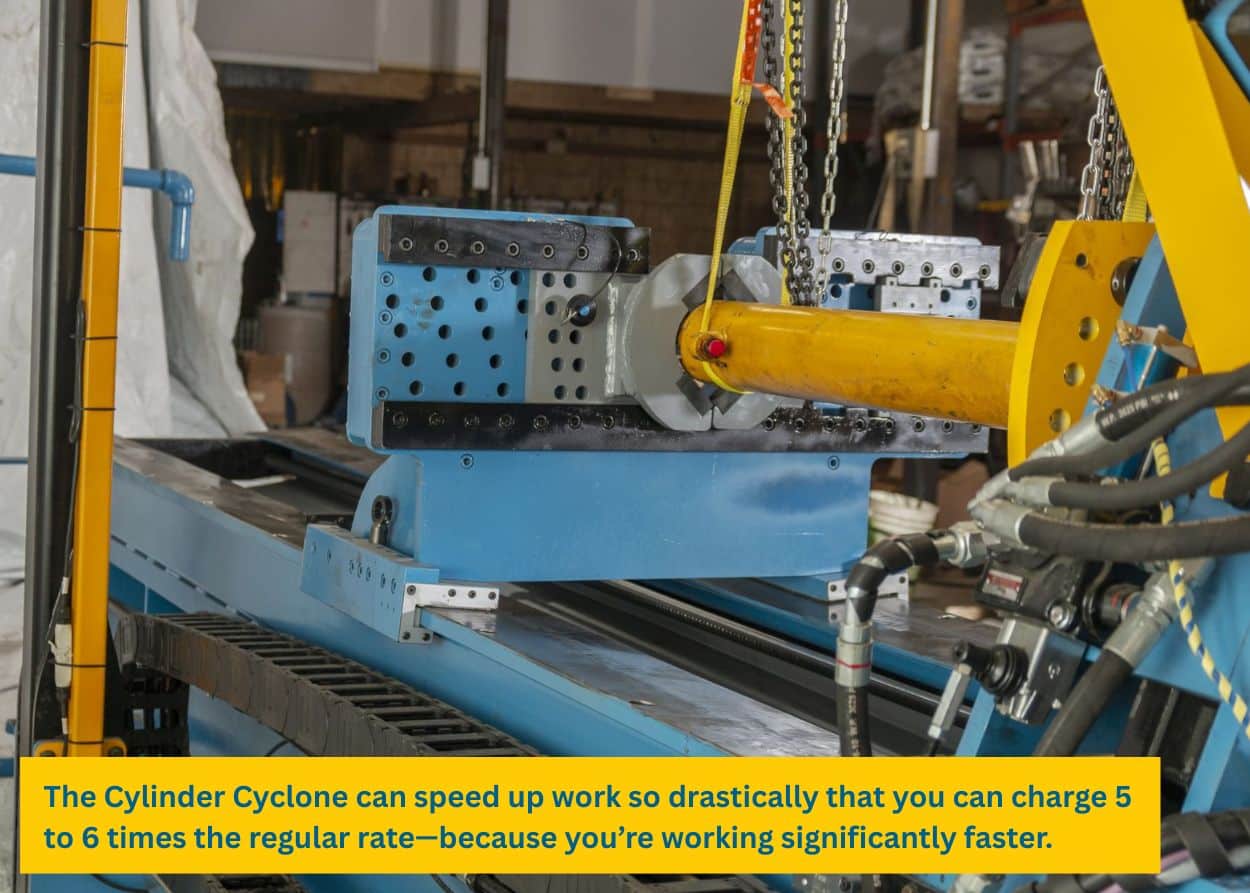
Why? Because the Cylinder Cyclone can speed up work so drastically, you can charge 5 to 6 times the regular rate—because you’re working significantly faster. Your customers will love your efficiency.
So, with this example:
- 5X-6X regular shop rate—shops typically charge an hourly rate (typical shop rate = $100.00/hr)
- Cylinder cyclone rate=$550.00/hr
- 1 average cylinder takes about 0.5 hrs to break apart, put back together, and pressure-test.
Let’s say you work five cylinders a day. That breaks down to:
- $1375.00 per day
- $6875.00 per week
- $350,000.00 per year
This example ignores reduced rework, fewer damaged components, and safety and insurance benefits—so real payback is often higher.
One other return on investment—this time intangible—is the trust and goodwill you would have fostered with your customer for that quick turnaround time, building a reputation for fast, excellent and efficient service.
A quick buyer’s checklist
Use this to compare two or three benches side-by-side:
- Capacity fit: Covers your largest bore, rod, stroke, and overall length with margin.
- Torque & control: Breaks the worst glands you see, with fine control and readout for reassembly.
- Tooling protection: Jaws/fixtures that won’t mar chrome or crush threads; proper adapters included.
- Set-up speed: Adjustable supports/centers and slides for fast and safe positioning by a single technician.
- Guarding & E-Stop: Interlocked shields, clear labels, and a reachable emergency stop. Task-based risk reduction aligns with ANSI B11 practices.
- LOTO-friendly: Obvious isolation points and a lockable disconnect; vendor supplies LOTO steps/training aids.
- Testing & filtration: Integrated or companion test stand, adequate filtration, and oil containment.
- Footprint & flow: Fits your bay with crane access, safe aisles, and clean oil handling.
- Build & components: Rigid frame, quality hydraulics and electrics, tidy plumbing/wiring.
- Docs & PM: Manuals, prints, PM schedule, and spare parts availability.
- Support: Training, commissioning, tech support, and an explicit warranty.
- Total ROI: Time saved, rework avoided, safety improvements, and resale value.
Where Cylinder Cyclone fits
Choosing the right hydraulic cylinder repair bench is about finding the perfect fit: one that suits your cylinders, your space, your safety program, and your budget. Start with the work you do, insist on built-in safeguards and LOTO-friendly design, make room for clean handling and testing, and run the ROI. Get those right, and your bench will improve throughput, reduce rework, and protect your team.
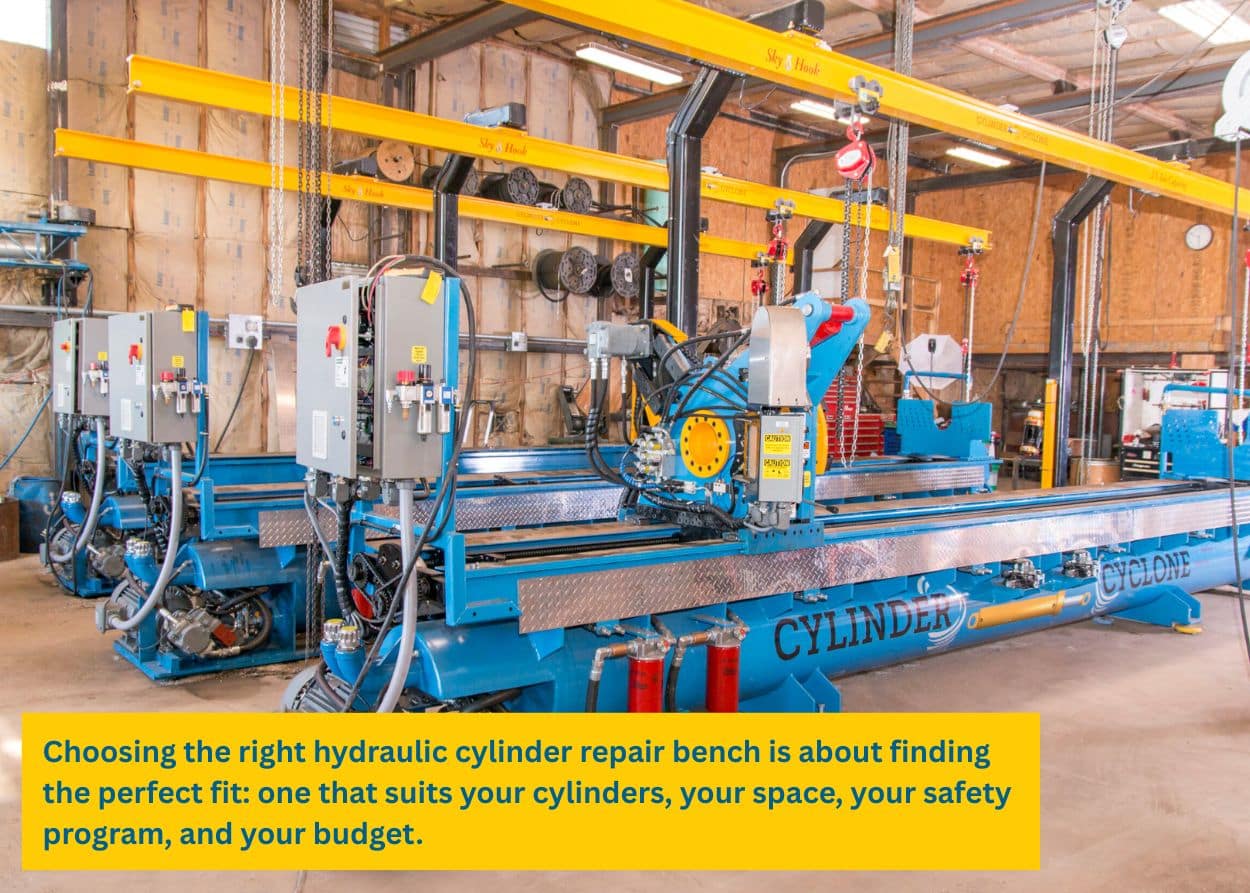
When you’re ready to talk specifics, Cylinder Cyclone is here to help you build a safer, faster, cleaner cylinder bay—one that pays you back every day. Suppose you’re matching a bench to specific cylinders (ag, construction, refuse, mining, municipal, or industrial). In that case, our team can help you pick capacities, tooling, and test options that fit your work—and your space. We’ll walk you through layout questions, safety features, training, and long-term service so your bench pays for itself with reliable, repeatable work.
Cylinder Cyclone manufactures hydraulic cylinder rebuilding machines designed for real-world shops that need power, control, and safety without the drama. Based in Harrisonburg, VA, we serve customers across North America with benches and tooling designed to handle tough cylinders, helping technicians work more safely and keep jobs moving.
Contact us today to set up your new bench!