Is a Hydraulic Cylinder Repair Bench Worth It? 4 Ways a Repair Bench Pays You Back
Your best technician has been on one cylinder for half the day.
It's a big one, and the nut holding it together is seized tight. Out come the sledgehammer and the torch. Meanwhile, the skilled labor you're paying for is stuck on a single job. At this point, your options aren't great. You can choose to continue the struggle or you can send the cylinder to another shop and wait on their schedule instead of yours. Either way, it costs you.
A hydraulic cylinder repair bench is built to solve this problem. It's a machine that lets your shop tear down, rebuild, and pressure-test cylinders in one place. And it's faster and safer than doing it by hand.
But let's be honest, a repair bench is a real investment, and "it'll make you faster" isn't necessarily enough of a reason to sign a purchase order.
We're Cylinder Cyclone, and we build these benches. But we didn't start as a machine company. We started as a cylinder shop, and back in 2013, we got frustrated enough with the equipment out there that we built our own to fix it. That's the short version of why we can talk about this credibly. Let's walk through this together.
TL:DR - Is a Hydraulic Cylinder Repair Bench Worth It?
- A hydraulic cylinder repair bench turns slow, hands-on rebuilds into fast, billable work.
- We've seen average teardown and rebuild time drop by 50% to 80%.
- Most of our customers pay the machine off in under 2 years at light use, around one hour of machine time a day.
- The all-in-one design means no separate test rig and no cutting your shop floor for a concrete pad.
- If you're sending cylinder work out or turning jobs away, the math usually favors owning your own repair bench.
What a Repair Bench Actually Does for Your Bottom Line
Think of a repair bench less like a tool and more like added capacity. It's the difference between a line cook chopping every vegetable by hand and one with a prep station built for the job. Same cook, but there are a lot more plates going out the door. (If you want the mechanical side first, we cover how a repair bench works in a separate guide.)
A good bench helps you by:
- Making each job faster, so labor hours drop.
- Keeping work in-house, so you stop paying another shop's margin.
- Freeing up capacity, so you can say yes to more cylinders.
4 Ways a Repair Bench Pays You Back
Here's where that payback comes from. Let's look at each one.
1. The Hours You Save on Every Cylinder
Doing a cylinder by hand is slow and physical. You're fighting seized parts, wrestling heavy steel, and hoping you torque everything back to spec without guesswork.
A repair bench takes the fight out of the process. On our machine, we've seen shops cut their average repair time by 50% to 80%. A job that used to swallow most of a day can clear in a fraction of it.

How? A few things work together:
- Bi-directional torque up to 60,000 ft-lbs, so stuck nuts come loose without a sledgehammer or a torch.
- A wireless remote that runs the machine's functions, so one person can work safely from a distance.
- An overhead hoist lined up on center, so a single tech can lift and align a heavy cylinder without a second set of hands.
Let's put a dollar figure on this. A heavy equipment technician earns a median of about $62,740 a year, or roughly $30 an hour, according to the U.S. Bureau of Labor Statistics, and that's before benefits and overhead. So when a rebuild that used to eat most of a day clears in a couple of hours, you're freeing up your most expensive labor to bill on other work.
Here's what that time buys you: more finished jobs per week from the same crew, and a shop set up for efficient repairs.
2. The Jobs You Stop Sending Out
Every cylinder you ship to another shop is margin you hand to someone else. You also wait on their schedule, not yours.
Bring that work in-house, and the margin stays with you, and your turnaround is in your own control.
This isn't a hypothetical. One shop told us the Cylinder Cyclone lets them process every cylinder right in their own shop, and they were confident it had paid for itself.
3. The New Work You Can Take On
Faster jobs plus in-house work adds up to something bigger: room to grow.
When you can turn cylinders around quickly and reliably, you become the shop other operators call. You're not just keeping up. You're the local repair expert people drive to. That speed matters to them. When a machine is down in the middle of a job, equipment downtime can run into thousands of dollars a day.
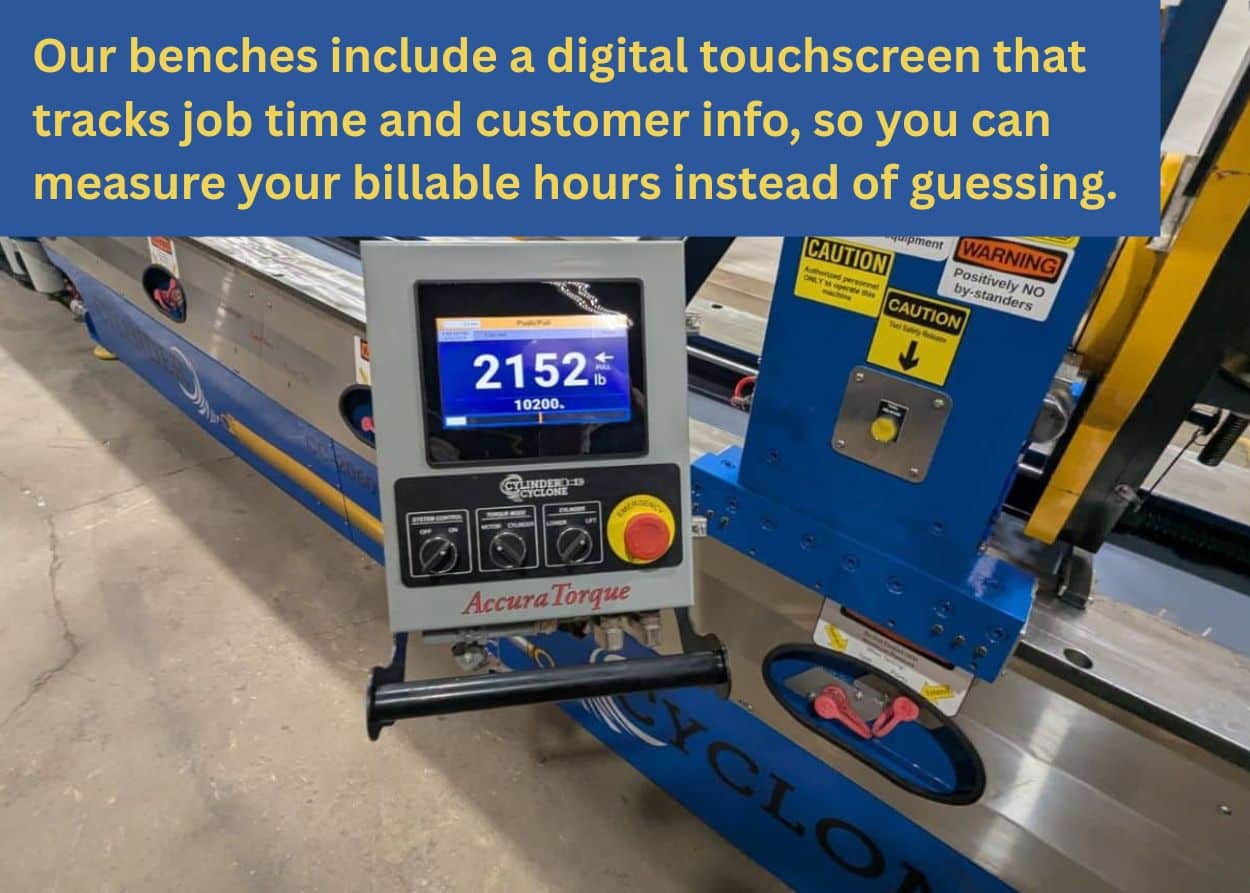
Our benches include a digital touchscreen that tracks job time and customer info, so you can measure your billable hours instead of guessing. That's the kind of data that tells you when it's time to add a second machine or a second tech.
4. How Fast It Pays for Itself
On average, our customers pay off their machine in less than two years when they charge their normal bench rate for about two average excavator cylinders per day, or roughly one hour of machine time a day.
That's not much use to ask of a machine. This isn't a "run the thing flat out" projection. It's what happens at modest, realistic daily use.
And you don't have to cover the whole cost up front. Financing is available, so you can spread the cost out while the machine is already earning. That changes the question from "can I afford this today" to "does the monthly payment come in under what this machine brings in?"
How to Know If Your Shop Is Ready
A bench isn't right for every shop, so here's a simple way to tell. A repair bench tends to pay off when:
- You're regularly sending cylinder work out or turning it away.
- A single large cylinder ties up a technician for most of a day.
- You want to grow repair revenue without piling on labor.
- You're worried about the safety of the manual, high-force way you do it now, given the injection-injury risks that come with hydraulic work.
If two or more of those sound like your shop, it's worth running the numbers in detail and thinking through how to choose the right bench for the work you already do.
FAQ
How much time does a hydraulic cylinder repair bench really save? On our machine, shops have cut average teardown and rebuild time by 50% to 80%. Your actual savings depend on your cylinder mix and how you work now.
Do I need to modify my shop floor to install one? Not with ours. The Cylinder Cyclone is free-standing and sits on any level surface, so there's no floor cutting or concrete pad required. Some competing benches do require that prep.
How long until it pays for itself? Most of our customers pay theirs off in under two years at light use, about one hour of machine time per day.
Can one person run it? Yes. A wireless remote and a centerline overhead hoist are built specifically so one technician can set up and run a heavy cylinder safely.

What size cylinders can it handle? The standard bench fully services cylinders up to 24 inches in diameter and a 10-foot stroke, and it can loosen and tighten glands and pistons on cylinders up to 20 feet long. Longer capacities are available as an add-on. Full specs are on our machine specifications page.
So, Is It Worth It?
A repair bench is a real expense. We won't pretend otherwise.
But the slow way has a price too. Every hour your best tech spends fighting a seized nut, every cylinder you hand to another shop, and every job you turn away because you're at capacity is already costing you money.
We started Cylinder Cyclone because we got tired of paying those costs in our own shop. When we saw how well our machine worked, we started building them for other shops too.
If you want to see how it adds up for your shop, our team will put together a quote with the machine model, tooling, and upgrades that fit. No pressure, just a clear picture. You can request a quote here whenever you're ready.